
Phone:
+86-13450578802


Views: 0 Author: Site Editor Publish Time: 2026-11-21 Origin: Site


Commercial building codes heavily mandate domestic hot water recirculation loops. They prevent dangerous Legionella growth within long plumbing lines. These networks also ensure rapid hot water delivery everywhere. However, these loops inherently conflict against fundamental CO₂ refrigerant physics. CO₂ systems thrive when heating extremely cold municipal water. Feeding a warm recirculation loop directly back destroys efficiency. It triggers immediate high-pressure lockouts inside the compressor. This practice fundamentally degrades your overall equipment lifespan. We must define the engineering realities for commercial environments. You need practical ways to manage warm return water effectively. We detail established plumbing architectures preserving high system performance. You will learn how to maintain strict local code compliance. These actionable strategies will protect your valuable mechanical investments perfectly.
Directly routing a DHW recirculation loop into a CO₂ heat pump fundamentally breaks the required temperature differential (ΔT).
Swing tanks (temperature maintenance tanks) are the industry standard for decoupling the warm return loop from the primary cold-water heating cycle.
Thermal stratification management is critical; misplaced return lines will mix the tank, reducing the capacity of the primary heat pump.
Failed check valves and improper venting in the return loop account for the majority of post-commissioning performance failures.
Transcritical CO₂ cycles operate differently from traditional gas boilers. They do not condense the refrigerant. Instead, they cool a supercritical fluid across a gas cooler. This unique process demands cold water. It relies on a large CO₂ heat pump water-side temperature difference. The refrigerant must cool down drastically before hitting the expansion valve. If the water absorbing this heat is already warm, the refrigerant stays hot. It fails to reach the necessary subcooled state. This physics clash disrupts the entire refrigeration cycle.
Problems arise quickly when return water enters the primary unit. Standard municipal cold water usually enters around 50°F. Recirculation loops typically return water at 115°F. Introducing this warm water creates a massive thermal penalty. Your operational efficiency plummets immediately. The system Coefficient of Performance (COP) drops sharply. You also face severe risks of high discharge pressures. These pressures trigger automatic system lockouts to protect the compressor. Consequently, the unit suffers an inability to maintain the target CO₂ heat pump hot water temperature. Buildings lose hot water capacity quickly under these conditions.
Despite these physics challenges, recirculation is mandatory. We must acknowledge this strict compliance reality. Organizations like ASHRAE publish clear guidelines for pathogen control. Plumbing codes strictly require recirculation loops in commercial facilities. Hotels, hospitals, and multifamily buildings cannot legally operate without them. We cannot simply cap off the return lines. We must engineer smart solutions around the thermal limitations. You must decouple the warm return loop from the cold primary heating cycle.
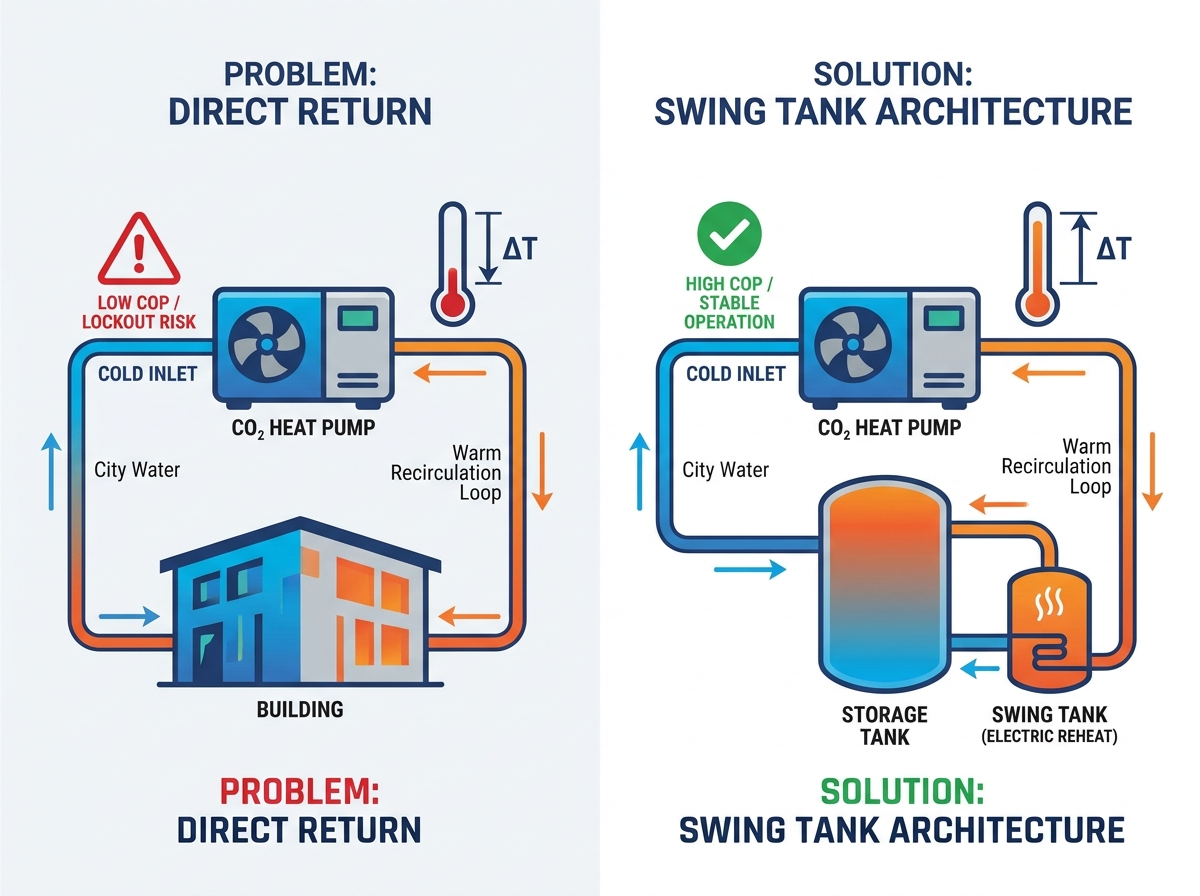
This approach solves the warm water problem reliably. The warm return loop completely bypasses the primary CO₂ storage tanks. It enters a smaller, dedicated electric resistance tank instead. We call this secondary unit the "swing tank." The swing tank reheats the loop water independently. This mechanism protects the CO₂ temperature differential entirely. You trade a small amount of grid-electric usage for maximum efficiency. The loop temperature remains steady. The primary heating load operates at peak COP. This remains the safest choice for a commercial CO₂ heat pump water heater.
Some engineers prefer returning water directly to the primary tank. They route the warm water to the exact tank mid-point. This method relies heavily on natural thermal layers. It attempts to keep the bottom inlet strictly cold. The evaluation here demands caution. It is highly dependent on precise flow controls. You must use low-velocity diffusers. There is a high risk of destratification during low-draw periods. If not perfectly engineered, the tank mixes. The primary heat pump will then inhale warm water and fail.
Heat pumps use different internal flow configurations. We must evaluate whether your unit is single-pass or multi-pass. Single-pass systems require a high temperature differential. They heat water to the target temperature in one motion. Multi-pass systems cycle water multiple times. They can handle varying inlet temperatures better. However, they operate at a significantly lower overall efficiency. Clarifying this distinction is vital. Multi-pass is rarely the optimal choice for pure CO₂ commercial systems. Single-pass systems deliver far superior energy savings when decoupled properly.
Strategy | Mechanism | Primary Advantage | Primary Risk |
|---|---|---|---|
Swing Tank | Dedicated electric tank reheats return water. | Guarantees cold inlet for CO₂ plant. | Requires extra floor space and electrical wiring. |
Mid-Point Return | Returns water to the middle of the storage tank. | Uses fewer tanks and reduces upfront plumbing. | High risk of destratification and system lockout. |
Multi-Pass | Cycles water through the compressor repeatedly. | Tolerates warm inlet temperatures better. | Significantly lowers overall system COP. |
We must move away from arbitrary sizing methods. You need to calculate exact BTUs lost in the commercial pipe run. Insulation thickness, pipe diameter, and building temperature matter. Gather these variables to size the swing tank accurately. Over-sizing wastes space and electrical capacity. Under-sizing causes the swing tank to run constantly. Calculate the specific heat loss per linear foot. Multiply this by the total recirculation loop length. This formula determines the exact maintenance heater capacity required.
Sensor placement dictates how the system reacts. Where you place temperature sensors matters immensely. Incorrect placement forces the recirculation pump to short-cycle. It might also inadvertently call the primary CO₂ plant. Place the aquastat on the return line right before the swing tank. Set the deadband properly to avoid rapid switching. The swing tank element should trigger only when the loop drops below safe levels. The primary CO₂ system sensors must remain strictly in the cold storage tanks.
Modern pumping technology improves loop management drastically. Electronically Commutated Motor (ECM) pumps play a huge role. They automatically adjust flow based on line pressure and temperature. Variable speed pumps minimize return water velocity. Slower velocity preserves thermal stratification inside tanks. These pumps also reduce parasitic energy draw significantly. Constant speed pumps agitate the water needlessly. They destroy temperature layers and inflate electricity bills. Specify ECM pumps for all commercial CO₂ loop designs.
This remains the most common field issue. We call it the "warm water in cold line" failure. A failed check valve causes immediate problems. Sometimes plumbers seat the check valve improperly in the recirculation loop. This allows unexpected backflow. Loop pressure pushes hot water into the cold municipal feed. The cold feed line becomes warm. This destroys the heat pump's cold inlet temperatures. The unit locks out on high pressure. Always install heavy-duty spring-loaded check valves to prevent this cross-connection.
Air inside the plumbing loop stops water circulation completely. Discuss the necessity of automatic air vents (AAVs). Install AAVs at the highest points of the commercial loop. When air gets trapped, the recirculation pump spins dry. This causes severe cavitation in the pump impeller. Cavitation leads to rapid flow failure. The loop temperature drops drastically, risking Legionella growth. Proper venting protocols ensure continuous, quiet, and reliable water flow.
You cannot skip proper system commissioning. A visual inspection is never enough. Thermal imaging is non-negotiable before signing off on the installation. Use thermal cameras to track water flow visually. Verify the cold inlet stays truly cold during pump operation. Conduct manual temperature verification at the return connection. Prove the check valves hold against back-pressure. Find the thermal leaks before you hand the keys over. Thorough commissioning prevents frantic emergency calls later.
Different facilities demand different recirculation strategies. High-volume, clustered draw buildings need robust protection. Multifamily buildings and hotels fall into this category. The swing tank with dedicated electric resistance is generally the safest compliance path. It handles morning shower spikes flawlessly. Conversely, industrial processing facilities have continuous, predictable draws. They use hot water constantly without massive spikes. Stratified single-tank returns may be viable here. You must use highly engineered flow controls for this to work safely.
Facility Type | Draw Pattern | Recommended Architecture |
|---|---|---|
Multifamily Housing | Clustered (Morning/Evening Spikes) | Swing Tank System |
Large Hotels | Clustered (High Peak Loads) | Swing Tank System |
Industrial Processing | Continuous / Predictable | Mid-Point Stratification (with diffusers) |
Hospitals | Mixed / High Sanitation Need | Swing Tank System |
You must align your teams before purchasing equipment. We strongly recommend a joint review of plumbing schematics. Bring the MEP engineer and the heat pump manufacturer together. Do this prior to final procurement. Verify the loop heat loss calculations together. Confirm the swing tank capacity matches the pipe run length. Ensure check valves exist on every cold feed branch. Collaborative planning prevents expensive piping teardowns after the walls close.
You cannot force a commercial CO₂ heat pump to act like a traditional gas boiler. They follow different thermodynamic rules. Successfully managing recirculation requires decoupling the maintenance load from the primary heating load. Swing tanks handle the loop heat loss safely. The primary heat pump handles the massive municipal cold water lift efficiently. Designing for the physics of CO₂, rather than fighting it, yields great results. It ensures system longevity. It guarantees health code compliance. It delivers the massive utility savings you originally expected.
Decouple the warm return loop using a dedicated electric swing tank.
Protect the primary heat pump's cold inlet temperature at all costs.
Install heavy-duty check valves to prevent warm water backflow.
Calculate exact loop heat loss rather than guessing tank sizes.
Demand thermal imaging during the final system commissioning phase.
A: No. This destroys the required ΔT immediately. It severely reduces system efficiency. Warm return water causes the compressor to overheat. The unit will automatically shut down on high-pressure limits to protect itself. Always decouple the return loop.
A: A swing tank is a secondary, smaller water heater. We usually use electric resistance models. It is dedicated solely to reheating the water returning from the building's recirculation loop. This absolutely protects the primary CO₂ system from warm water.
A: As the inlet water temperature rises, the compressor must work significantly harder. It struggles to achieve the necessary subcooling across the gas cooler. This results in an exponential drop in COP. Your heating capacity falls drastically.
A: This typically indicates a failed check valve. We call this a cross-connection. It might also mean a missing thermal trap. Loop pressure pushes the warm return water backward. It forces hot water directly into the municipal cold supply line.
