Home » News » Heat Pump COP vs. Seasonal Efficiency: Which Figure Should Buyers Compare?

Heat Pump COP vs. Seasonal Efficiency: Which Figure Should Buyers Compare?

Views: 0     Author: Site Editor     Publish Time: 2026-11-26      Origin: Site

Inquire

facebook sharing button
twitter sharing button
line sharing button
wechat sharing button
linkedin sharing button
pinterest sharing button
whatsapp sharing button
sharethis sharing button

For heat pump COP vs seasonal efficiency, buyers should use seasonal efficiency for annual energy screening, then verify COP at the exact design points that matter to the project: ambient temperature, leaving-water or sink temperature, load profile and system boundary.

Commercial heat pump efficiency comparison for hot-water and HVAC procurement

COP and seasonal efficiency measure different decisions

COP is a point-condition ratio, while seasonal efficiency is intended to represent performance over a broader operating period.

COP

ENERGY STAR defines COP for air-source heat pump equipment as the ratio of average space-heating delivered to average electrical energy consumed at a single set of operating conditions.

Use COP to test whether a proposed unit can satisfy the hard design case: low outdoor temperature, high water temperature, or another specified point.

Seasonal efficiency

ENERGY STAR describes HSPF2 as a seasonal heating-performance metric for a heating season.

For water heaters, ENERGY STAR uses Uniform Energy Factor as an overall water-heater efficiency measure determined by the DOE test method referenced on its water-heater criteria page.

Figure Best buyer use Comparison caution
COP Check a defined operating point such as a design ambient condition or high leaving-water temperature. Do not compare two COP values unless the operating conditions are the same.
HSPF2 or other seasonal HVAC metric Screen space-heating equipment for seasonal energy performance. Confirm the rating basis before using it for a climate or duty cycle that differs from the project.
UEF for water-heater categories Compare water-heater efficiency terminology where the product category and test method apply. Do not treat UEF as the same thing as a single-point COP.

Readers can verify the COP and HSPF2 terminology on the ENERGY STAR heat pump equipment criteria. Water-heater UEF terminology is described on the ENERGY STAR water heater criteria.

Which number should a buyer compare first?

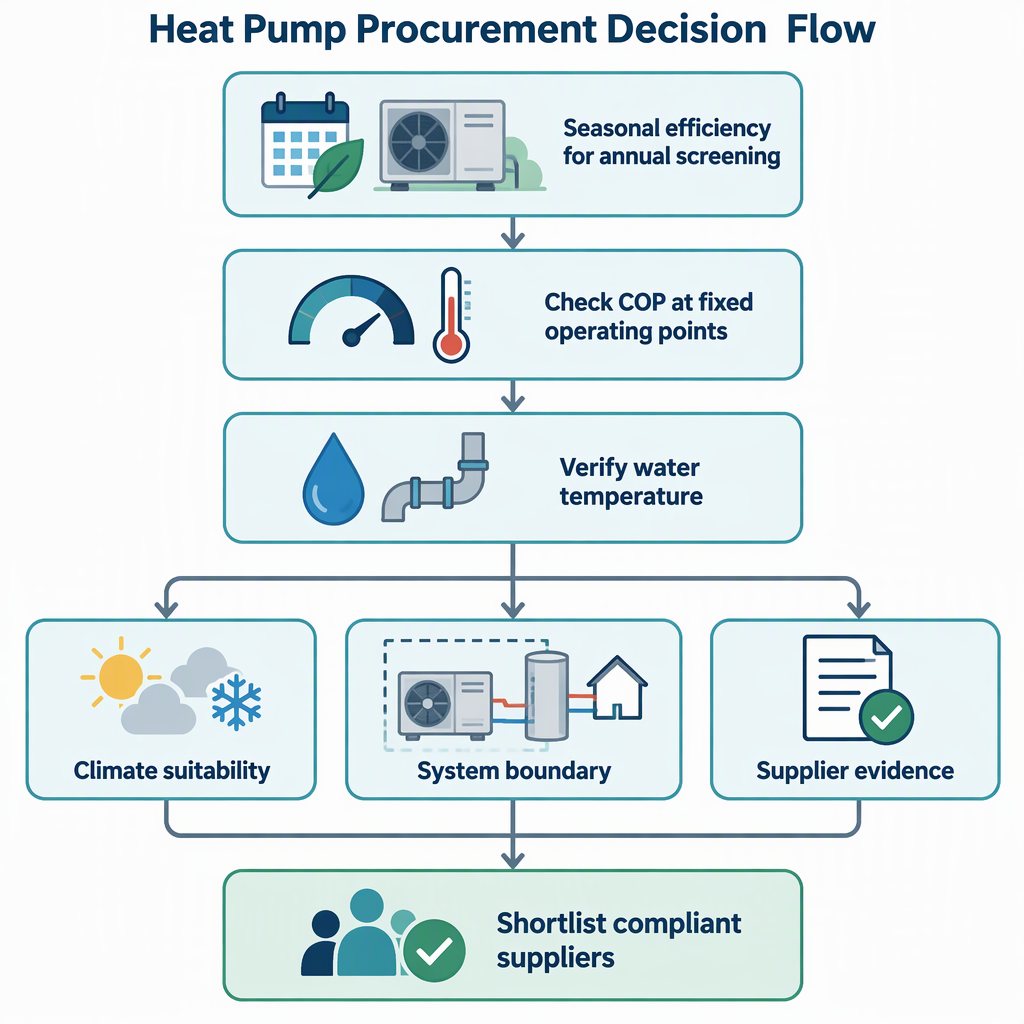
Start with the seasonal figure when the first question is annual energy use, then use COP to check the conditions that can make or break the design.

Decision flow from seasonal efficiency screening to COP verification at fixed operating conditions
Buyer question Compare first Then verify
Which option is likely to use less energy across the heating season? A seasonal metric such as HSPF2 where the equipment category and rating basis apply. Project climate, load hours and controls.
Can the system meet a high-temperature hot-water duty? COP at the required sink or leaving-water temperature, because DOE commercial heat-pump work highlights high sink temperature as a design focus. Capacity at that condition, backup heat strategy and storage arrangement.
Is a water-heater comparison being made under a covered category? UEF where the water-heater category and DOE test method reference apply. First-hour rating, cut-off temperature reporting and project draw pattern.

A commercial hot-water project can be constrained by sink temperature, so a seasonal headline number should not replace a design-point check for the required water temperature.

Keep test conditions identical before ranking two options

A fair comparison holds the test condition, load boundary and rating basis constant before ranking two heat-pump options.

  • Ask for COP at the same ambient temperature and delivered-temperature condition, because COP is tied to a single set of operating conditions.
  • If using HSPF2, confirm the equipment category and seasonal-rating basis rather than mixing it with a design-point COP.
  • If comparing heat-pump water heaters, identify whether UEF is the applicable overall water-heater efficiency figure for the product category.
  • Ask each supplier to state the refrigerant, compressor operating envelope, control assumptions and whether auxiliary heat is included in the reported result.
  • Use the same project boundary for both options: heat-pump unit only, packaged water-heater system, storage tank, pumps, backup heaters or complete plant.
  1. Define the useful output: space heating, domestic hot water, process hot water or combined service.
  2. Set the design points: entering air, water inlet, leaving-water or sink temperature, flow rate and load profile.
  3. Select the rating figure: seasonal metric for annual screening, COP for fixed-point verification, or UEF where the water-heater category applies.
  4. Request the same data fields from every shortlisted supplier and reject comparisons that mix different boundaries.

Water temperature, climate and system design change the result

The more a project pushes toward low ambient conditions or high sink temperatures, the more important it becomes to check COP at the project’s actual design points.

Project variable Why it changes the comparison Buyer action
Outdoor climate Heat-pump criteria distinguish seasonal performance and low-ambient considerations, so a warm-climate comparison may not describe a cold-climate duty. Request performance at the project’s winter design condition.
Water or sink temperature DOE’s commercial high-temperature heat-pump work focuses on systems capable of elevated sink temperature, showing why hot-water temperature is a core operating boundary. Compare capacity and COP at the required leaving-water temperature.
Water-heater duty profile ENERGY STAR water-heater criteria include UEF and first-hour rating, so efficiency and hot-water delivery should be checked together where that category applies. Match the rating data to peak draw and recovery requirements.
System design boundary Storage, backup heat, pumping energy and controls can shift project energy use even when unit-level figures look similar. Ask for a system-level energy model when the plant boundary differs between options.

Do not assume a published seasonal number proves performance at every water temperature or climate condition. Require a written schedule of rated points, permitted operating range and any auxiliary heat assumptions before awarding the project.

Cost comparison needs energy, equipment and site assumptions

The better efficiency figure is not automatically the lower-cost project; compare the energy model, equipment scope, installation work and maintenance assumptions together.

  • Energy input: electricity tariff, demand charges where applicable, operating hours and load profile.
  • Equipment scope: heat-pump unit, tanks, pumps, controls, backup heaters, heat exchangers and monitoring.
  • Site work: electrical capacity, ventilation or acoustic treatment, pipework, structural supports and commissioning.
  • Operating care: filter or coil maintenance access, water treatment requirements and service availability.
  • Risk allowance: low-ambient operation, high leaving-water temperature, downtime tolerance and redundancy.
Cost decision Metric to use Do not substitute
Annual energy screening Seasonal heating performance where the rating basis applies. A single COP measured at favorable conditions.
High-temperature hot-water design COP and capacity at the required sink temperature. A seasonal average that hides the design point.
Water-heater category comparison UEF and hot-water delivery criteria where applicable. Space-heating metrics from a different product category.

No supplier should be selected on efficiency language alone. Ask for the calculation file or schedule that shows the same load profile, weather assumption, water temperature and included equipment boundary for both options.

What to request from suppliers before purchase

Ask suppliers for rating evidence, matched-system information where applicable and project-specific performance points before treating two proposals as comparable.

  • COP at named operating conditions, including ambient temperature and delivered heating condition.
  • Seasonal efficiency figure, rating basis and equipment category for HVAC comparisons.
  • UEF, first-hour rating and compressor cut-off temperature reporting where heat-pump water-heater criteria apply.
  • AHRI reference numbers or certificates for matched split systems where that certification route applies.
  • Refrigerant declaration, permitted operating envelope and safety documentation relevant to the project location.
  • Clear statement of whether pumps, tanks, controls, backup heat and defrost energy are included in the quoted efficiency or energy model.
  • Commissioning and measurement plan showing which temperatures, flow rates, energy inputs and operating hours will be logged after installation.

AHRI explains that higher SEER or HSPF indicates more efficient equipment in its covered context and advises verification of matched systems through AHRI reference numbers or certificates where applicable; buyers can review that general principle on AHRI’s efficiency guidance.

Conclusion

Compare seasonal efficiency first for annual screening, then use COP at fixed project conditions to confirm that the shortlisted heat pump can satisfy the required duty.

  • COP is useful only when the operating condition is defined.
  • Seasonal metrics support broader energy screening when the rating basis matches the equipment and climate use case.
  • UEF belongs to water-heater efficiency comparisons where the applicable category and test method apply.
  • High-temperature commercial hot-water projects need design-point checks at the required sink temperature.
  • Rating and matched-system evidence should be requested where applicable instead of relying on brochure language.

For procurement, the practical rule is simple: compare like with like. Use the same water temperature, climate assumption, load profile, refrigerant disclosure, system boundary and test condition for every proposal before ranking efficiency or cost.

FAQs

These questions help buyers turn efficiency terminology into comparable supplier requirements.

Can a higher COP alone prove that one heat pump is better?

No. COP is tied to a single set of operating conditions, so a higher value is meaningful only when both options are measured at the same ambient temperature, delivered temperature and boundary.

Is UEF the same as COP for heat-pump water heaters?

No. ENERGY STAR uses UEF as an overall water-heater efficiency measure for covered water-heater criteria, while COP is a point-condition ratio.

Should buyers ask for third-party rating or matching evidence?

Yes, where the equipment category has an applicable rating or certificate route. AHRI notes that matched split systems should be verified through reference numbers or certificates where applicable.

When should seasonal efficiency be the first comparison?

Use seasonal efficiency first when the buyer’s question is annual heating energy and the rating basis matches the equipment category and intended climate use.

When should COP be the deciding figure?

COP becomes decisive when the project has a hard design condition, such as high sink temperature in commercial water heating, that must be met reliably.

Can buyers estimate operating cost from COP alone?

No. Operating-cost comparison also needs load hours, tariffs, water temperature, climate data, system boundary and auxiliary-energy assumptions.

How should refrigerant be handled in the comparison?

Ask each supplier to state the refrigerant, permitted operating envelope and project-relevant safety documentation, then compare efficiency only within those declared limits.

What is the simplest way to avoid an unfair comparison?

Issue one data template to every supplier and require the same temperatures, climate basis, load profile, included components and test conditions before ranking options.

CO2 Heat Pump Manufacturer
Phone:
+86-13450578802
Sanshui district, Foshan City
No.5, 2nd Road, Shihuzhou Industrial Zone, Yundonghai Street
​Copyright ©️ 2024 Foshan LYD Energy Saving Technology Co., Ltd.   All Rights Reserved. Support by leadong.  Sitemap / Privacy Policy