
Phone:
+86-13450578802


Views: 0 Author: Site Editor Publish Time: 2026-11-08 Origin: Site


Plant managers face mounting pressure to decarbonize process heating today. You must cut emissions to meet stringent corporate sustainability goals without disrupting production reliability or ballooning operating costs. Industrial heat pumps offer a proven way to capture low-grade waste heat and upgrade it for high-value reuse. However, they are not a universal plug-and-play replacement for fossil-fuel boilers. Simply swapping equipment often leads to operational bottlenecks and wasted capital.
Upgrading requires a rigorous assessment of your facility's heat sinks, source temperatures, and electrical infrastructure. You need to know exactly what your factory can support before requesting vendor bids. This guide provides a pragmatic, engineering-focused checklist. We will help you determine if your facility is technically and financially ready for this transition. You will learn how to map thermal baselines, evaluate refrigerant capabilities, and build a solid, evidence-based business case that satisfies both engineering and finance departments.
Successful integration relies on a tight match between waste heat availability (source) and continuous process demand (sink).
Industrial CO₂ heat pump systems offer a future-proof, compliant alternative to synthetic refrigerants, particularly for generating temperatures up to 90°C–120°C.
Financial viability hinges heavily on the "spark spread" (the local ratio of electricity costs to natural gas costs) and achievable Coefficient of Performance (COP).
Retrofitting requires evaluating physical footprint constraints and potential electrical capacity upgrades before finalizing vendor selection.
Before looking at equipment, you must establish your operational reality. We need to map the thermal baseline to understand the core business problem. This means understanding exactly where heat comes from and where it goes.
First, identify your waste heat sources. You should audit your cooling towers, compressor rooms, and refrigeration racks. Check wastewater effluents and exhaust stacks for recoverable thermal energy. You must detail the required volume and consistency of this heat. Does it flow continuously, or does it peak during specific production shifts? Evaluating the quality of this heat is crucial. A steady 35°C water stream from a cooling circuit is often more valuable than a fluctuating 60°C exhaust gas stream.
Next, define the heat sink, or your heat demand. Map out the specific processes requiring heat across your factory floor. Common examples include washing stations, pasteurization loops, drying kilns, and boiler feedwater preheating. You need to know the exact temperature and flow rate required for each distinct process.
Finally, consider the simultaneity requirement. Waste heat generation and heat demand must overlap in time. If a batch process generates waste heat at noon, but your washing station needs hot water at midnight, a direct heat pump application will struggle. If they do not overlap, you will need expensive, lossy thermal storage solutions like massive buffer tanks. Continuous, simultaneous operation ensures maximum equipment utilization, higher efficiency, and a much faster return on investment.
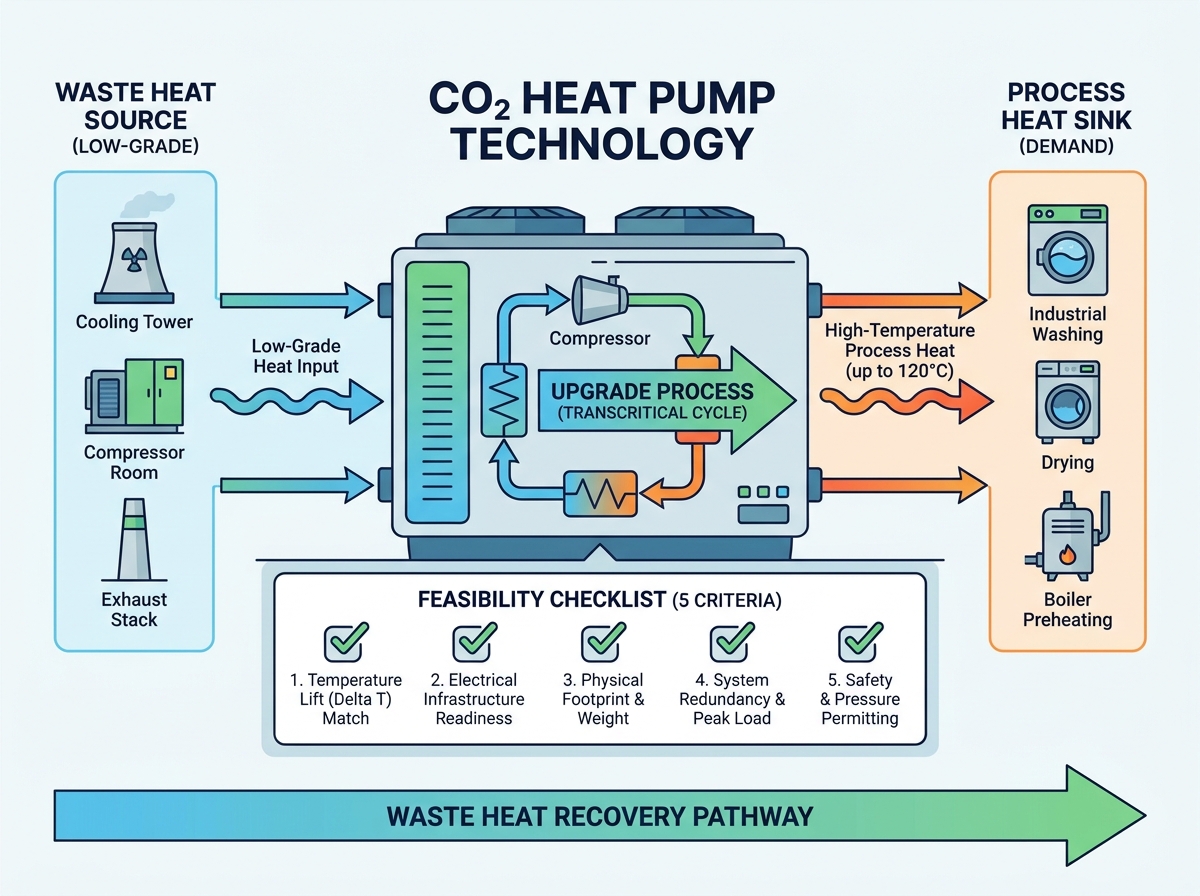
Refrigerant choice directly dictates what your equipment can achieve and where it can be installed. The industrial heating sector is currently experiencing a massive shift toward natural refrigerants. Regulatory bodies in Europe and North America are aggressively phasing down F-gases and heavily scrutinizing PFAS-related synthetic refrigerants. This regulatory landscape makes carbon dioxide (CO₂, or R744) a highly attractive option. It offers a Global Warming Potential (GWP) of exactly 1 and acts as a long-term compliance safeguard. You will not face sudden regulatory bans or expensive refrigerant retrofits using CO₂.
To understand why this matters for your factory, we must look at CO₂ heat pump technology fundamentals. The transcritical cycle operates differently than traditional vapor compression cycles found in standard chillers. It does not condense the refrigerant at a constant temperature. Instead, it utilizes a gas cooler to reject heat from the supercritical gas across a wide temperature range. This unique thermodynamic behavior explains why it excels at large temperature glides. It efficiently heats cold incoming water to very high temperatures in a single, continuous pass.
This capability is crucial for pushing the temperature envelope in manufacturing environments. These advanced systems bridge the gap for high-temperature process heating solutions. Traditional gas boilers easily produce high-pressure steam, but older synthetic heat pumps typically struggled to produce water hotter than 60°C. Today, realistic maximum output temperatures for transcritical CO₂ systems reach up to 120°C. This exceptional thermal output makes them viable for demanding industrial applications that previously relied entirely on fossil fuels.
You need a rigorous core evaluation framework to determine factory readiness. Not every facility is built to support heavy thermal electrification. We developed this five-point technical checklist to guide your preliminary engineering assessment.
You must carefully assess the gap between the waste heat source and your target process temperature. Engineers call this the temperature lift. A smaller lift yields a higher Coefficient of Performance (COP). For instance, if your waste heat source is 30°C and your target process requires 80°C, the lift is 50°C. A lift under 60°C generally ensures excellent electrical efficiency. Larger lifts are certainly possible with modern compressors, but they will consume more electricity, which directly impacts your operating margins.
Electrifying process heat requires serious power. Industrial CO₂ heat pump systems require significant amperage to operate their large, high-pressure compressors. You must outline the need to audit your current switchgear early in the planning phase. Check your main transformer capacity and sub-panel ratings. Many older factories lack the spare electrical capacity needed for a megawatt-scale thermal installation. Upgrading this grid infrastructure adds considerable time and capital to your project, so you must identify these bottlenecks immediately.
Retrofitting brings spatial realities into sharp focus. High-pressure compressor skids, large heat exchangers, and associated buffer tanks take up valuable floor space. They are also incredibly heavy due to the robust materials required for high-pressure operation. You must evaluate your existing mechanical rooms. Can the concrete floor slab support the added dynamic weight? Is there enough door clearance to maneuver the equipment into place? In some cases, facilities must build an external enclosure or reinforce existing structures.
You must evaluate how the new equipment fits into your overall thermal grid. Will the heat pump serve as the sole heating source or the baseload provider? In many highly successful industrial setups, the heat pump handles 80% to 90% of the annual heating hours. Existing natural gas boilers are then retained solely for peak demand spikes or backup redundancy. This hybrid approach minimizes your initial capital risk while maximizing your overall decarbonization impact.
CO₂ systems operate at much higher pressures than traditional ammonia or HFC refrigerants. You must acknowledge these high operating pressures during the initial planning stage. Necessary inspection, piping certification, and ventilation compliance checks are required. Ensure your facility meets local and national industrial pressure vessel regulations. Proper safety protocols, relief valves, and burst discs are standard equipment, but navigating the local permitting process can take time. Plan your project timeline accordingly.
Table: Factory Integration Feasibility Summary
Evaluation Criterion | Key Consideration | Ideal Scenario for Integration |
|---|---|---|
Temperature Lift (ΔT) | Gap between heat source and target | ΔT under 60°C for optimal COP and lower electricity usage |
Electrical Capacity | Available switchgear amperage | Sufficient spare capacity without requiring transformer upgrades |
Physical Footprint | Space and floor load limits | Accessible mechanical room with reinforced flooring and high clearance |
System Redundancy | Baseload vs. peak demand sizing | Heat pump handles steady baseload; legacy boilers kept for backup |
Safety Permitting | High-pressure vessel regulations | Clear pathway for pressure vessel compliance and safety protocols |
A successful engineering project must also make undeniable financial sense. We need to ground the technical evaluation in financial reality using transparent assumptions and proven economic frameworks.
You must move beyond manufacturer "best-case" numbers when building your financial model. Real-world efficiency fluctuates based on several environmental and operational variables. Explain to your stakeholders how fluctuating seasonal ambient temperatures affect annual efficiency. If your waste heat comes from an outdoor cooling tower, the water will be colder in the winter months. A colder source temperature increases the required temperature lift, which inherently lowers the COP. Always calculate your return on investment using a conservative, annualized COP rather than peak summer performance metrics.
Financial viability depends heavily on your local utility rates. We use the "spark spread" framework to analyze this dynamic. It compares the cost of industrial electricity to the cost of natural gas or fuel oil. If electricity is five times more expensive than gas per kilowatt-hour, a heat pump with a COP of 3.0 will still cost more to run than a traditional boiler. You need a favorable spark spread—typically a ratio lower than your average COP—to achieve operational expense (Opex) parity or generate meaningful savings.
When evaluating the initial capital expenditure (Capex), you must factor in the full equipment lifespan and secondary operational savings. Do not look at the sticker price in isolation. Consider the secondary financial benefits that improve the business case. For example, capturing waste heat directly reduces the thermal load on your cooling towers. This leads to significantly reduced cooling tower water consumption, lower chemical treatment costs, and decreased fan energy usage. You must also budget accurately for the specialized maintenance required for high-pressure components over the system's operational life.
Decarbonization incentives can drastically improve your project's financial outlook. Highlight how these government programs compress the payback period. In the United States, the Inflation Reduction Act (IRA) offers substantial tax credits for industrial electrification. In Europe, Green Deal grants provide direct funding for energy efficiency projects. These subsidies often reduce the payback period from an unappealing seven or more years down to an attractive three to five years, making the project highly competitive for internal capital allocation.
You need to mitigate adoption risks before signing any purchase orders or finalizing facility layouts. Guiding the procurement process requires careful vendor shortlisting logic and a clear understanding of common integration hurdles.
Many industrial projects fail to meet expectations because engineering teams overestimate waste heat quality. They assume a heat source is constant when it actually fluctuates wildly between shifts. You must measure the source continuously with data loggers for at least a week to capture true operational profiles. Another common pitfall is underestimating controls integration. Integrating new PLC controls with legacy factory SCADA systems is notoriously complex. It requires specialized automation engineers to ensure seamless, automated communication between the new heat pump and your existing boiler network.
You must ask tough, specific questions when shortlisting vendors. Use this criteria to narrow down your options and find a reliable partner:
Do they have proven, verifiable case studies in your specific industry vertical? A food and beverage plant has vastly different sanitation and washdown requirements than a heavy chemical processing facility.
Can they provide robust Service Level Agreements (SLAs)? Specialized CO₂ compressors require highly trained technicians. You need guaranteed response times for maintenance and emergency repairs to prevent production downtime.
Do they offer performance guarantees tied to the annualized COP, rather than just laboratory test conditions?
Are they experienced in navigating local pressure vessel permitting for transcritical systems?
Do not request vendor quotes based on guesswork or incomplete data. We strongly recommend starting with a Level 1 Pinch Analysis. Alternatively, commission a targeted thermal energy audit from an independent engineering firm. This preliminary engineering study will quantify your exact thermal flows, pinpointing the best opportunities for heat recovery. It provides the hard, empirical data you need to size the equipment correctly, avoid overcapitalization, and solicit accurate, comparable bids from manufacturers.
Industrial heat pumps are highly effective decarbonization tools, but they require specific operational profiles to deliver a strong return on investment. You cannot simply drop them into an old boiler room and expect immediate success. By rigorously assessing your factory's thermal dynamics and infrastructure, you protect your capital and ensure reliable production.
Verify your thermal overlap: Ensure your waste heat generation and process heat demand occur simultaneously to avoid expensive thermal storage.
Analyze the spark spread: Confirm your local electricity and gas rates support long-term operational savings based on your projected COP.
Assess your infrastructure: Audit your electrical capacity, switchgear, and physical floor space before committing to a system design.
Demand industry-specific proof: Only work with integrators who understand the unique regulatory and operational demands of your manufacturing vertical.
Passing this feasibility checklist ensures your facility is ready to move from theoretical decarbonization to a concrete engineering study. Take action today. Commission a thermal pinch analysis or contact a specialized engineering consultant to quantify your exact waste heat recovery potential and start building your business case.
A: Currently, industrial CO₂ systems can realistically generate hot water up to 120°C. This makes them ideal for pasteurization, washing, and drying processes. However, for applications requiring higher temperatures or direct high-pressure steam, auxiliary heating methods like electric boilers or legacy gas systems are still required to bridge the gap.
A: Yes, they are very safe when designed correctly. CO₂ systems operate at high pressures, but they are built to strict industrial pressure vessel regulations. They include standard safety protocols, robust piping, mechanical pressure relief valves, and burst discs to prevent over-pressurization and ensure safe daily operation.
A: The ROI typically ranges from three to seven years. This timeline depends heavily on your system's Coefficient of Performance (COP), total annual run-hours, and local energy rates (the spark spread). Utilizing government grants and decarbonization subsidies can significantly compress this payback period toward the three-year mark.
A: Usually, no. Heat pumps excel at generating hot water, but they are not drop-in replacements for direct high-pressure steam generation. Most factories use them to preheat boiler feedwater or handle lower-temperature baseloads, while retaining the existing steam boiler for peak demand and specialized high-temperature processes.
