
Phone:
+86-13450578802


Views: 0 Author: Site Editor Publish Time: 2026-11-23 Origin: Site


A CO₂ (R744) heat pump can supply high-temperature hot water because the CO₂ is heated past its critical point — about 31 °C and 73.8 bar — and cooled as a single-phase fluid, releasing heat across a wide glide rather than condensing at one temperature. Whether it can serve your project depends on your required leaving-water temperature, source and ambient design point, and the pressure and charge documentation the supplier provides — settle those numbers before requesting a quotation.
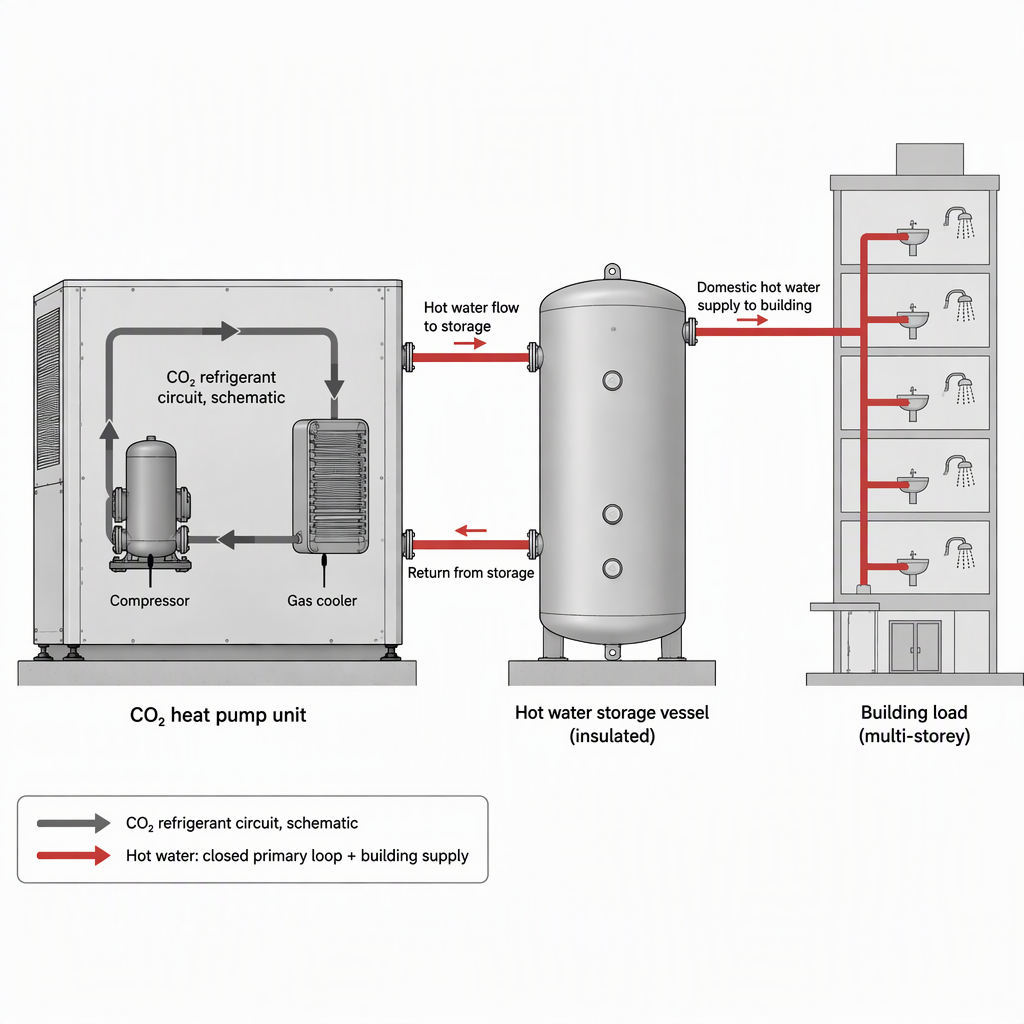
A CO₂ heat pump reaches high water temperatures because it does not have to condense its refrigerant at a fixed temperature. The refrigerant is carbon dioxide, CAS Registry Number 124-38-9, also designated R744. NIST reference data give carbon dioxide a critical temperature of about 304.18 K (roughly 31 °C), a critical pressure of about 73.80 bar and a triple point near 216.58 K at 5.185 bar. Above that critical pressure the CO₂ is cooled as a single-phase fluid, so heat passes to the water over a temperature glide rather than at one condensing temperature — which is why water well above 31 °C is achievable.
Those phase-change values come from the NIST Chemistry WebBook carbon dioxide record, a US National Institute of Standards and Technology reference database. They describe pure CO₂, not any heat pump's performance; achievable leaving-water temperature and efficiency depend on the unit's design and your operating point.
Transcritical means the high-pressure side of the circuit runs above CO₂'s critical pressure of about 73.80 bar, so the high-side heat exchanger cools a single-phase fluid instead of condensing it. Published research on transcritical CO₂ heat pumps notes that this high operating pressure raises leakage risk and that an undercharged system loses performance. The compressor, gas cooler, pipework and controls must therefore be rated for the pressures reached, and refrigerant charge becomes a design and service consideration rather than a one-off fill.
Refrigerant behaviour: the high-side refrigerant condenses at close to a constant temperature.
Water-side effect: the delivery temperature stays tied to that condensing temperature.
Equipment effect: conventional high-side pressure ratings suit the design.
Confirm: the maximum condensing temperature and the water temperature the unit holds at it.
Refrigerant behaviour: the CO₂ is cooled as a single-phase fluid and its temperature falls continuously.
Water-side effect: the delivery temperature becomes a control target, so water is heated well above 31 °C.
Equipment effect: the high side, its pipework and its components must be rated for the pressures reached.
Confirm: the maximum working pressure of the unit and its components, and the charge-integrity procedure.
High-pressure work is not a site-level improvisation. Installation, leak checking and any work on the refrigerant circuit belong with qualified personnel working to the unit's manual and to the pressure-equipment rules that apply where you install it. Before any inspection or in-place maintenance task, switch the unit off and disconnect it from its power supply at the local isolator, and leave the refrigerant circuit closed — do not open, vent or top up a CO₂ circuit yourself. Because charge loss degrades performance, ask the supplier how charge integrity is verified over the service life and what leak detection the unit provides.
There is no fixed ceiling that applies to every CO₂ heat pump, because the critical point sets the physics rather than the product limit. What you can reach depends on the unit's compressor, gas cooler and pressure rating combined with your entering-water and source conditions.
Manufacturer statements are a starting point, not a design point. Foshan LYD Energy Saving Technology Co., Ltd., a Foshan-based manufacturer of CO₂ (R744) heat pumps, publishes air-source, water-source and high-temperature units and customised configurations, and states solution-level hot-water figures of 90 °C for district heating and 98 °C for residential and small-commercial use, alongside a CO₂ heat pump air heater listed at 120 °C. Treat those as published application targets: ask for the leaving-water temperature, capacity and test conditions behind any figure.
Temperature and efficiency move together. Because transcritical operation links the delivery temperature to the high-side pressure the compressor must produce, a hotter water target changes the pressure ratio and the glide across the gas cooler, and a system that has lost charge performs below its rating. Ask for capacity and coefficient of performance at your own entering-water, source and leaving-water temperatures, and treat a single headline COP with no stated test point as uncomparable.
The 90 °C and 98 °C values are the application temperatures the manufacturer publishes: supplier statements rather than independently tested results. A listed air-heating temperature is not automatically a water-side temperature, so request the rated data sheet with its test conditions, and ask for third-party verification where your project depends on it.
CO₂ is a conditional choice, and the decision rests on the design point rather than on the refrigerant: the leaving-water temperature the building or process actually needs, the source and ambient temperatures you design for, the pressure and charge handling your site can support, and the performance evidence your supplier will document.
High-temperature heat pumps are a technology category in their own right — the IEA Heat Pumping Technologies TCP ran Annex 58, “High-Temperature Heat Pumps”, from January 2021 to December 2023 with participating countries including China, Denmark, Germany and Japan, covering available and near-market technologies and integration concepts — so it is reasonable to define your design point precisely and to expect the offer to answer it.
| Project condition | Why it matters | What to confirm before you award |
|---|---|---|
| Required leaving-water and entering-water temperatures | In transcritical operation the delivery temperature is tied to the high-side pressure the unit has to produce | Rated leaving-water temperature and capacity at your stated entering conditions, not a family maximum |
| Source and ambient design point | An air-source unit follows ambient air; a water-source unit follows the water or glycol loop available on site | Ratings at your winter design condition, not only at a mild reference point |
| Site pressure and equipment readiness | The high side runs above about 73.80 bar, well above a typical low-pressure hot-water circuit | Maximum working pressure of the unit and its components, and the pressure-equipment rules that apply where you install |
| Refrigerant charge integrity | High operating pressure is associated with leakage risk, and low charge degrades performance | Leak detection, service access, and how charge integrity is verified over the unit's life |
| Performance documentation | Figures are only comparable when the test point behind them is stated | The test standard, the test conditions, and whether each value is measured or calculated |
| Supply scope and support | Offers differ in what is included between unit supply and a running system | Which items — controls, storage, installation, commissioning, maintenance — are in scope, and what your own contractor provides |
Cold weather does not rule CO₂ out, because nothing in the refrigerant sets a minimum ambient temperature. What changes is the design point: where the unit draws heat in winter, and how hard it must work to reach the same leaving-water temperature.
Air-source and water-source CO₂ units face very different winter source conditions. An air-source unit depends on ambient air, which falls with the weather; a water-source unit depends on the temperature and flow available in the water or glycol loop on site. Ask for two numbers at the cold end of your climate — heat output at your winter design condition and the performance figure at that same condition — plus how frost management on the air side affects delivered capacity. Sizing to a mild-condition rating leaves winter behaviour undocumented.
Refrigerant policy is a second reason CO₂ is specified for high-temperature hot water. The US EPA records CO₂'s global warming potential as 1 by definition, while many of the fluorinated gases it can replace have GWPs in the thousands or tens of thousands, and the European Commission reports that EU HFC supply fell by 45% between 2015 and 2024, with HFC use in refrigeration, air-conditioning and heat-pump equipment 10% lower in 2024 than in 2023.
Read both figures as context rather than as a compliance rule for your site. GWP values are revised with each assessment cycle — the EPA's current explainer uses IPCC Sixth Assessment Report (2021) values — and the European Commission's F-gas overview describes the European market under the EU framework, which is not a global requirement. If refrigerant choice affects your compliance position, check the rules where you install and operate, and compare offers on refrigerant designation and charge.
Send one complete design point and ask for one comparable offer. Definition and testing of heat-pump specifications is a project step in its own right — Annex 58 reports on it were published in 2024, including “Task 1 – Technologies” and a task on specification definition and testing (see the Annex 58 publications list) — so state the duty and the test point you expect the offer to answer.
Yes, a CO₂ heat pump can supply high-temperature hot water — conditionally. The answer holds when your required leaving-water temperature sits inside the unit's documented envelope, your source and ambient conditions are rated, your site can take a high-pressure circuit, and the supplier will publish performance at your own test point.
The decision is not “CO₂ or nothing”. It is whether a specific unit, at a documented design point, answers your temperature, climate, load profile and site rules better than the alternatives. Fix the design point, ask for rated data and test conditions in writing, and compare every offer on the same terms.
These are the questions buyers raise most often when they size a CO₂ hot-water system for a high-temperature duty.
There is no single number. The ceiling is set by the unit's compressor, gas cooler and pressure rating together with your operating conditions, not by the refrigerant itself, and suppliers publish very different application targets: some CO₂ units are offered for hot water at 90 °C for district heating and 98 °C for residential and small-commercial use, and one category is listed as a 120 °C air heater. Treat any published maximum as an application target and require the leaving-water temperature at your own entering-water and source conditions before you select.
Yes. A 60–65 °C delivery target sits below the solution-level temperatures CO₂ units are published for, such as 90 °C for district heating and 98 °C for residential and small-commercial hot water, so temperature is rarely the limiting factor. The selection questions shift to capacity, source temperature, and how the unit behaves across the daily load profile rather than at one peak hour.
Temperatures above 100 °C do appear in CO₂ product ranges — a CO₂ heat pump air heater is listed at 120 °C — but an air-heating rating is not a water-side rating, and a process above 100 °C is a different specification from domestic hot water. Ask what medium the figure applies to, what leaving temperature is achieved at your entering conditions, and what pressure rating the circuit then needs before you treat any such value as usable for your duty.
On direct global warming potential, yes: the EPA records CO₂'s GWP as 1 by definition, while many HFCs it can replace sit in the thousands or tens of thousands, and EU HFC supply fell 45% between 2015 and 2024. Two qualifications matter. A GWP comparison covers direct refrigerant emissions, not total system impact, and the EU figures describe the European market rather than a rule that applies everywhere. Weigh refrigerant choice against the efficiency the system delivers at your own conditions, and check the rules where you operate.
In transcritical operation the high side runs above CO₂'s critical pressure of about 73.80 bar, so the design pressure is well above that of a conventional low-pressure hot-water circuit. The exact figure is the manufacturer's to state: ask for the maximum working pressure of the unit and its components in writing and check it against the pressure-equipment rules where you install. Any work on the refrigerant circuit belongs with qualified personnel, with the unit switched off and disconnected from its power supply first.
Compare at your conditions, not at headline numbers. Ask every supplier for capacity and coefficient of performance at the same entering-water temperature, the same source or ambient condition and the same leaving-water temperature, plus the test standard used and whether each figure was measured or calculated. An offer with no stated test point cannot be compared with one that has it.
A CO₂ circuit is a sealed high-pressure system and should hold its charge, so routine top-ups are not the expectation. Published work on transcritical CO₂ heat pumps notes that high operating pressure raises leakage risk and that undercharge degrades performance, so ask what leak detection the unit provides, how charge integrity is checked during service, and what procedure applies if a charge loss occurs.
