
Best-fit signals
The project has a useful cold-to-hot water temperature rise, a predictable load, and a system design that keeps gas-cooler operation close to the intended control range.


Views: 0 Author: Site Editor Publish Time: 2026-11-19 Origin: Site


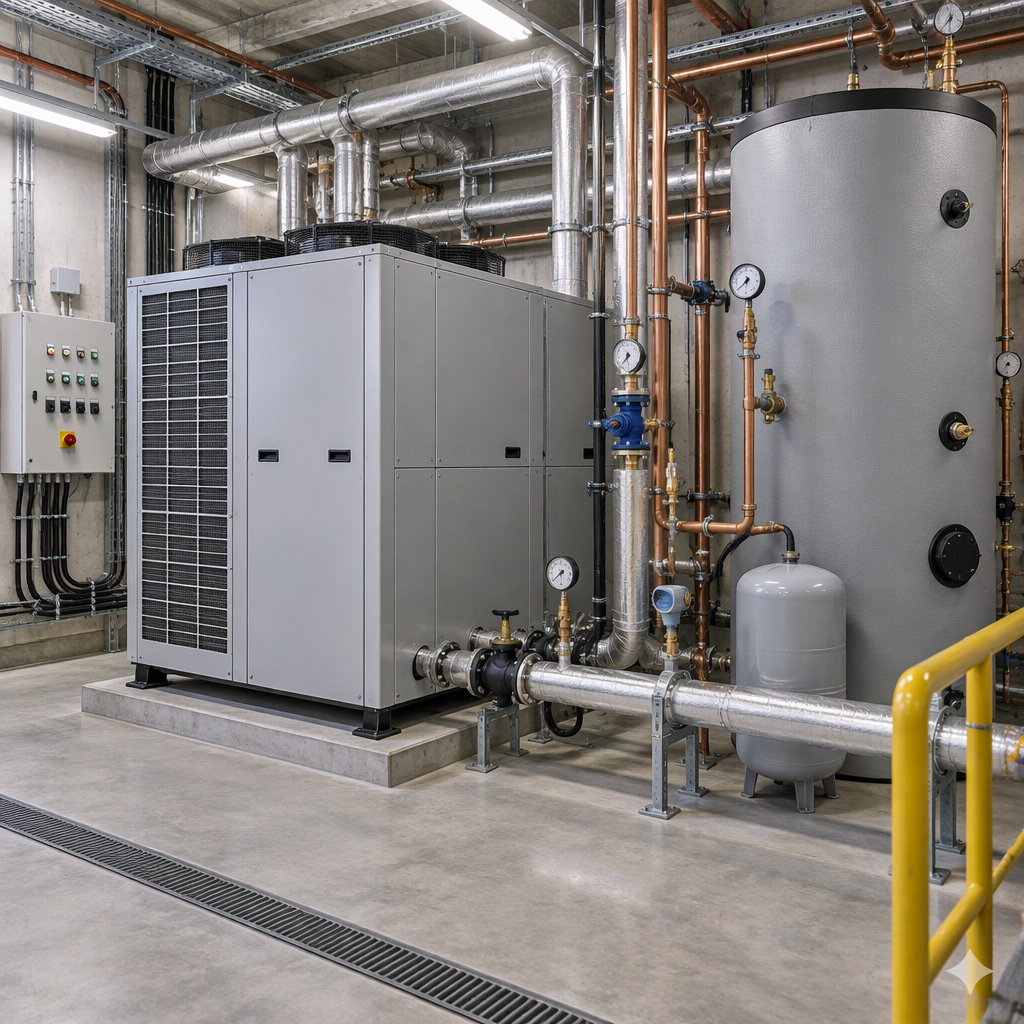
The CO2 heat pump working principle is a vapor-compression cycle adapted to R744’s low critical temperature: heat is absorbed on the low-pressure side, compression raises the pressure and temperature, and heat is rejected to water on the high-pressure side through gas cooling rather than ordinary condensation.
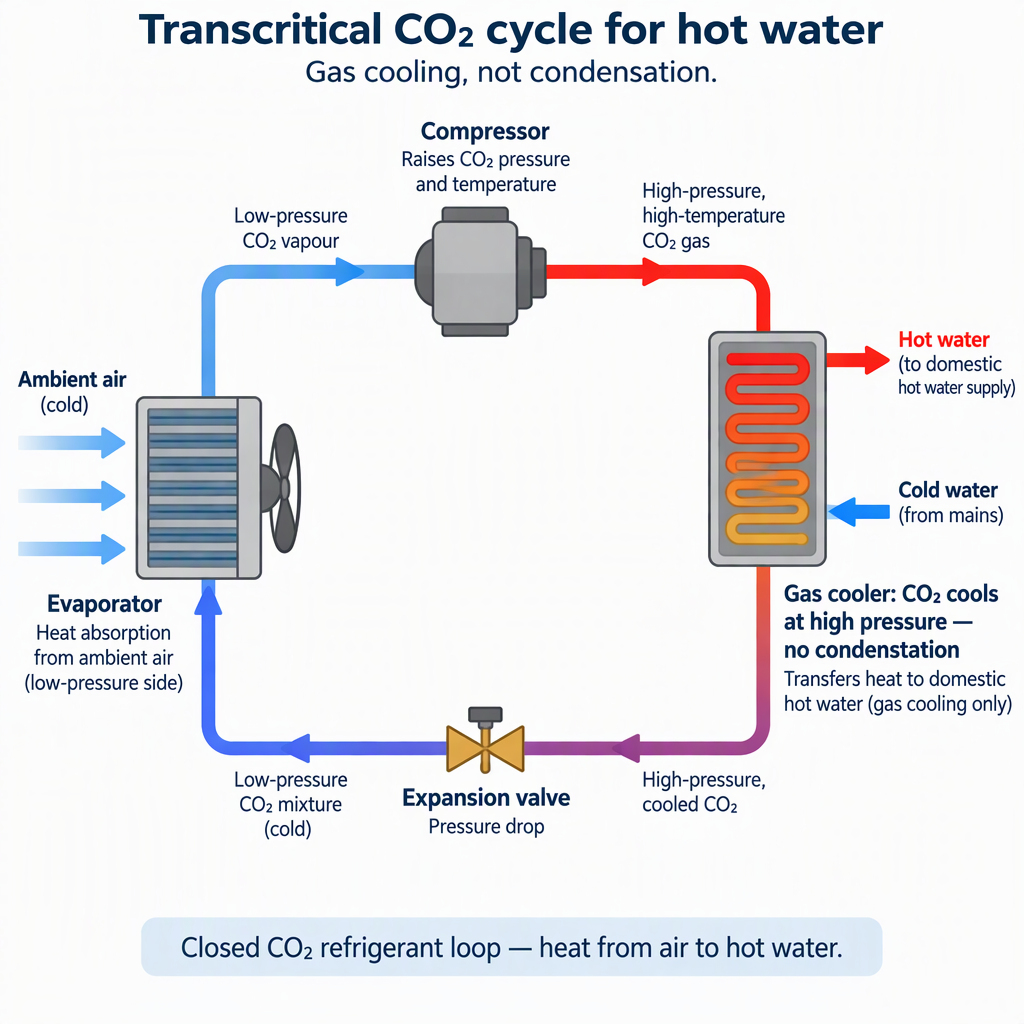
For buyers, the practical point is that the gas cooler can match a rising water-temperature profile. That is why the inlet water temperature, target outlet temperature, and flow pattern matter as much as the headline heating capacity.
Buyers consider CO2/R744 because the refrigerant has a very low climate-impact reference value: the EPA GWP reference table lists R-744 carbon dioxide with a 100-year global warming potential of 1.
| Buyer question | What CO2/R744 changes | What it does not prove by itself |
|---|---|---|
| Refrigerant environmental profile | R744 is listed by EPA with GWP 1. | A low GWP value does not automatically prove system COP, payback, or product certification. |
| Hot-water heat transfer | Transcritical operation rejects heat by cooling high-pressure gas, which can suit a water stream that rises in temperature through the heat exchanger. | It does not remove the need to check inlet water temperature, return temperature, and controls. |
| Pressure design | R744 systems require equipment and components designed for comparatively high operating pressures. | It does not mean a standard heat-pump design can be copied without CO2-specific engineering. |
Treat refrigerant choice as one part of the specification. For occupied spaces, plant rooms, and industrial areas, ask the system designer which CO2 concentration detection, ventilation, pressure-relief, and local compliance measures apply to the actual installation rather than borrowing rules from another application.
Transcritical CO2 is most relevant when a commercial or industrial project values higher-temperature water and can design the water side to take advantage of the temperature rise through the gas cooler; the U.S. Department of Energy notes this higher-temperature-water advantage in a commercial CO2 electric heat pump water heater context.
| Project condition | Fit signal | Buyer action before selection |
|---|---|---|
| Domestic or sanitary hot water with a meaningful temperature lift | The water stream can absorb heat across a rising temperature range. | Specify cold-water inlet, target storage temperature, peak draw, and recirculation return temperature. |
| Drying, washing, or process hot-water duties | A temperature-glide heat sink can be compatible with gas-cooler heat rejection. | Define the process temperature, flow stability, operating hours, and allowed supply-temperature variation. |
| Retrofit where capital cost sensitivity is high | Cost has been recognized as a barrier in the U.S. commercial market. | Compare lifecycle assumptions, electrical capacity, storage volume, backup heat, and maintenance access before choosing a system. |
A good-fit project is usually defined by the heat sink first. If the system mainly returns very warm water to the gas cooler, the design may lose some of the temperature-glide benefit and should be checked with project-specific calculations.
Performance depends heavily on gas-cooler outlet conditions and high-pressure control, so a supplier cannot size a CO2 hot-water system responsibly from a single outlet-temperature target.
Do not compare proposals only by nominal heating capacity. Two offers can look similar while using different inlet-water temperatures, source conditions, defrost assumptions, storage volumes, or backup-heater strategies.
A transcritical CO2 heat pump is not a universal replacement for every hot-water plant; its value depends on matching the temperature glide, controls, pressure design, installation context, and cost boundary to the project.
The project has a useful cold-to-hot water temperature rise, a predictable load, and a system design that keeps gas-cooler operation close to the intended control range.
The project has high return-water temperatures, uncertain draw patterns, poor heat-source data, or limited space for the storage, piping, controls, and service access the system requires.
R744’s high-pressure characteristics require CO2-specific design, components, commissioning, and service competence. Ask suppliers to identify the design pressure basis, pressure-relief approach, applicable local rules, ventilation or detection strategy, and who is qualified to service the installed equipment.
Also evaluate cost in context. Commercial CO2 electric heat pump water heaters can target valuable higher-temperature-water applications, but cost has also been identified as a market barrier, so procurement should compare installed scope rather than equipment price alone.
Before requesting a proposal, prepare enough project data for suppliers to separate a suitable CO2 heat-pump design from a generic hot-water estimate; Foshan LYD Energy Saving Technology Co., Ltd.’s public homepage identifies CO2 heat-pump categories, but project selection still needs project-specific data.
Choose a CO2 heat pump for hot water when the project’s temperature lift, heat source, controls, safety design, and commercial boundary support the transcritical cycle instead of treating CO2 as a one-feature specification.
The technical principle is clear: R744’s critical point leads many hot-water applications into transcritical heat rejection, where a gas cooler transfers heat to water without conventional condensation.
These questions help procurement, HVAC engineering, and facility teams turn the transcritical-cycle principle into a clearer specification.
No. Efficiency depends on operating conditions, especially gas-cooler outlet temperature and high-pressure control. Compare proposals at the same inlet water, outlet water, source temperature, and load conditions.
The gas cooler transfers heat while high-pressure CO2 cools through a temperature range, which can align well with water that enters cold and leaves hot.
In refrigeration terminology, R744 refers to carbon dioxide used as a refrigerant, and EPA lists R-744 carbon dioxide with a 100-year GWP of 1.
Compare rated capacity, COP, inlet and outlet water temperatures, heat-source temperature, storage assumptions, control logic, backup heat, and exclusions under the same test boundary.
A major design risk is underestimating the high-pressure nature of R744 equipment. Pressure design, qualified installation, relief strategy, and service competence should be confirmed before purchase.
Choose by source stability and project economics. A stable water source or waste-heat source can support different operating conditions than outdoor air, but the proposal should show the actual source temperature range and controls.
Sometimes, but not automatically. Check required supply temperature, return temperature, storage, peak recovery, backup heat, and whether the existing distribution system allows the heat pump to operate in its intended range.
