Compare a CO₂ vs conventional refrigerant heat pump only after fixing the same hot-water duty: inlet and outlet water temperatures, source temperature, load profile, storage strategy, controls and rating basis. CO₂/R744 can be a strong candidate for higher-temperature water, but published high-temperature heat-pump guidance also ties its attractiveness to conditions such as low heat-sink inlet temperature. For commercial heat pump water heaters, AHRI 1300/1301 defines a relevant performance-rating scope. EN 16147 is a domestic hot-water unit test context and should not be stretched to every commercial or industrial project.
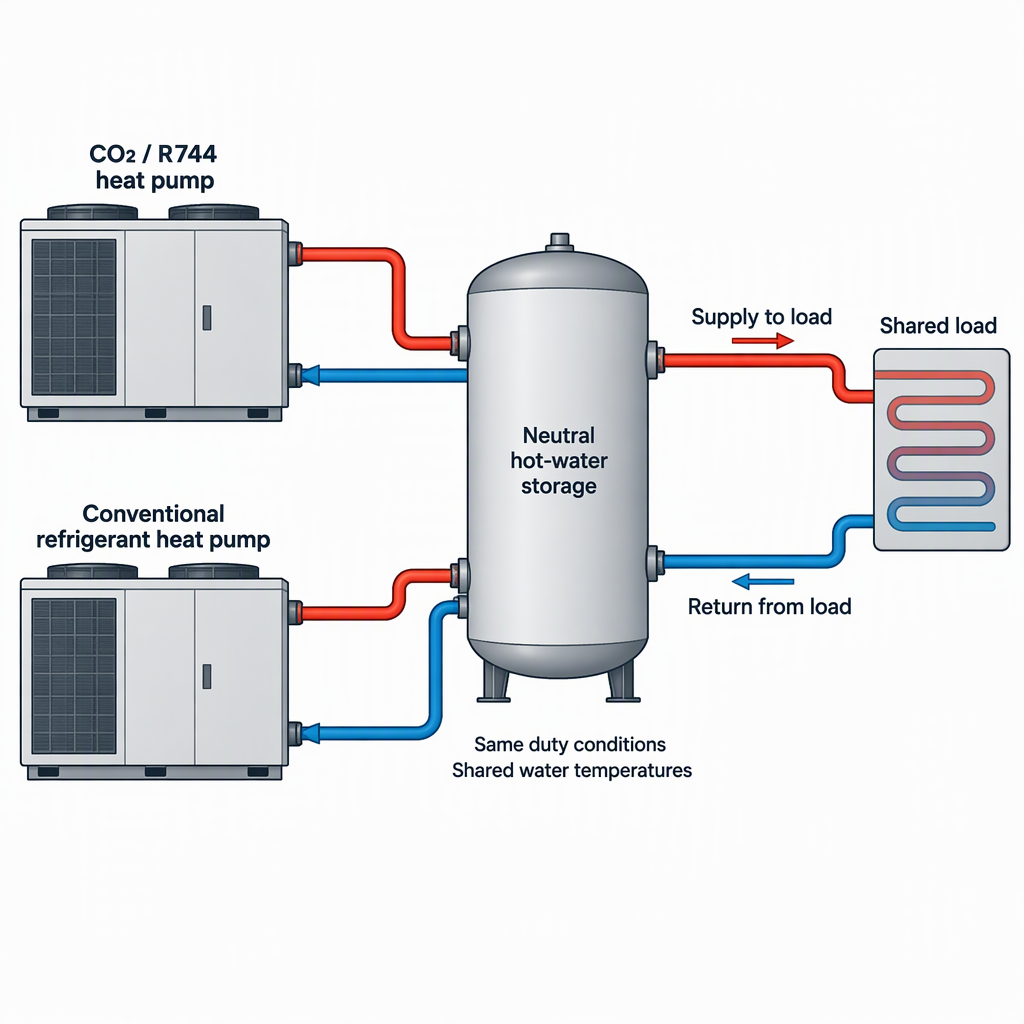
Compare CO₂ and conventional refrigerants under the same conditions
A fair comparison holds the duty constant first, then asks which refrigerant circuit, heat exchanger design and control package can meet that duty with acceptable efficiency, cost and service risk.
CO₂/R744 option
R744 is carbon dioxide and has a 100-year GWP value of 1 in the U.S. EPA Technology Transitions GWP reference table.
For heat pumps above 100°C, an IEA Heat Pumping Technologies publication identifies CO₂ among natural refrigerant options and states that CO₂ can deliver up to 130°C under the paper’s discussed application boundaries.
Conventional-refrigerant option
The EPA table lists higher 100-year GWP values for several conventional refrigerants used in the comparison context, including HFC-134a at 1,430, HFC-32 at 675 and R-410A at 2,088.
Its practical advantage may come from supplier availability, familiar service practices, lower pressure design, or better fit to moderate water-temperature lifts, but those points must be proven in the project submittal rather than assumed.
| Comparison item | What to hold constant | Why it matters |
| Hot-water duty | Entering water temperature, leaving water temperature and required flow | Changing any of these can change compressor lift and heat-exchanger performance. |
| Heat source | Ambient air, process waste heat, source-water loop or exhaust stream at the same design condition | The source condition can decide whether a quoted COP is relevant to the site. |
| Load profile | Peak load, daily volume, recovery window and standby requirement | Storage and controls can make two refrigerant options look different even with similar compressors. |
| Rating basis | Use a stated rating method when commercial heat pump water heater performance is compared. | AHRI 1300/1301 applies to factory-assembled commercial heat pump water heaters providing potable or service hot water from alternate energy sources using electrically driven vapor-compression systems. |
Where CO₂/R744 has a stronger selection case
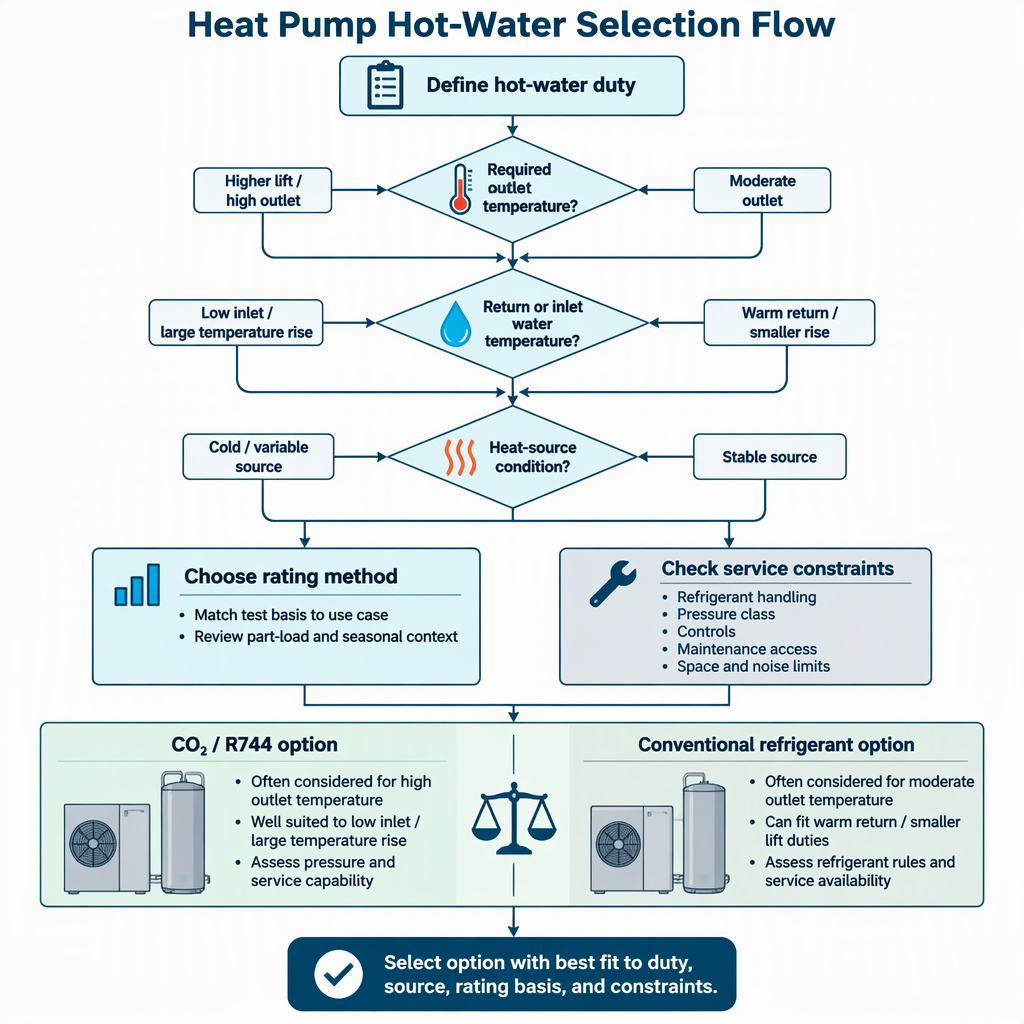
CO₂/R744 deserves closer review when the project needs high leaving-water temperature, has favorable entering-water conditions and can justify the system design needed for transcritical operation.
| Project condition | How it affects CO₂ review | Buyer action |
| High-temperature hot water | The IEA HPT publication discusses heat pumps above 100°C and states that CO₂ can deliver up to 130°C in the scope described on that publication page. | Ask suppliers for leaving-water temperature, entering-water temperature and capacity at the same rating point. |
| Low heat-sink inlet temperature | The same publication states that CO₂ is more attractive when heat-sink inlet temperature is below 30°C. | Measure return-water temperature instead of comparing only required supply temperature. |
| Large temperature glide opportunity | CO₂ systems are often evaluated where water heating can use a wide temperature rise through the gas cooler. | Require a hydraulic diagram showing flow arrangement, storage stratification and control logic. |
Do not choose CO₂ only because the outlet temperature is high. If return water is warm, if the load is intermittent, or if the supplier’s rating point does not match the site, the proposal still needs measured performance data for the actual duty.
Where conventional-refrigerant heat pumps may be easier to apply
A conventional-refrigerant heat pump may be the lower-risk option when the water temperature lift is moderate, service infrastructure is familiar and the quoted performance is clearly tied to the project’s test condition.
Good fit signals
- Moderate leaving-water temperature that does not require a specialized high-temperature design.
- Stable heat-source temperature close to the supplier’s published rating point.
- Local service capability for the proposed refrigerant and controls.
- Clear submittal data for part-load operation and storage integration.
Risk signals
- Some non-CO₂ refrigerants carry much higher 100-year GWP values than R744 in the EPA reference table.
- Published COP is given without entering-water temperature, leaving-water temperature or source condition.
- The quote excludes storage, pumps, heat exchangers, controls or compliance items needed by the actual system.
The IEA HPT publication frames natural refrigerant selection by application and notes different refrigerants have different strengths and weaknesses; that supports a boundary-based comparison rather than a universal winner.
Separate refrigerant impact from operating efficiency
Use GWP to compare refrigerant climate impact, but do not treat GWP as a substitute for measured system efficiency at the project duty.
| Refrigerant example | 100-year GWP value listed by EPA | How to use the value |
| R744 carbon dioxide | 1 | Useful for comparing refrigerant impact and leakage sensitivity. |
| HFC-134a | 1,430 | Consider refrigerant charge, service practices and applicable phase-down rules. |
| HFC-32 | 675 | Compare alongside safety, availability and rated performance. |
| R-410A | 2,088 | Do not compare refrigerants without also comparing the installed system duty. |
For the refrigerant-impact comparison, use the U.S. EPA Technology Transitions GWP Reference Table as a regulator-published reference for the listed 100-year GWP values. Efficiency, annual electricity use and project economics still require supplier data at the same operating conditions.
Check the rating method before comparing COP
COP comparisons are useful only when each supplier states the rating method, water temperatures, heat-source condition, flow assumptions and included auxiliaries.
| Reference point | Supported scope | Procurement use |
| AHRI 1300/1301 | The AHRI listing says ANSI/AHRI 1300-2013 (R2023) and 1301-2013 (R2023) cover performance rating of factory-assembled commercial heat pump water heaters for potable or service hot water using electrically driven mechanical vapor-compression refrigerant systems. | Use it as a commercial heat pump water heater rating reference when the proposed equipment fits the stated scope. |
| NEN-EN 16147:2017+A1:2023 | NEN lists this standard as current and describes it as covering testing, performance rating and marking requirements for domestic hot-water heat pump units with electrically driven compressors and a connected or included domestic hot-water storage tank. | Use it as domestic hot-water unit test context; do not apply it automatically to every commercial or industrial hot-water plant. |
Ask each supplier to state whether quoted COP includes pumps, fans, defrost, controls and standby losses. If two quotes use different boundaries, request a normalized calculation before making the refrigerant decision.
Build a cost comparison that matches the real system
Compare total installed and operating cost categories, not just the heat pump unit price.
- Heat pump package, compressors, heat exchangers and refrigerant circuit components.
- Hot-water storage tanks, buffer volume, stratification hardware and recirculation design.
- Source-side equipment such as air coils, water loops, waste-heat exchangers or exhaust interfaces.
- Electrical supply, demand charges, variable-speed drives, control panels and integration with the building or plant system.
- Installation labor, lifting, piping, insulation, commissioning and measurement equipment.
- Ventilation, refrigerant detection, pressure-relief routing and any local compliance measures required for the selected refrigerant and machine room.
- Planned maintenance, refrigerant service access, replacement parts and technician availability.
- Expected annual electricity use calculated from the same load profile and rating assumptions for both options.
Measure these project inputs before supplier selection
Before requesting quotations, collect the temperatures, flows, load timing and installation constraints that control the heat-pump selection.
- Required supply-water temperature, normal return-water temperature and maximum allowable recovery time.
- Hourly or daily hot-water demand, peak draw, minimum load and seasonal variation.
- Heat-source type and design condition: ambient temperature range, process-waste-heat temperature, source-water loop temperature or exhaust-air availability.
- Space, noise, ventilation, drainage, structural support and access constraints at the installation location.
- Existing storage volume, recirculation temperature, mixing valves and backup heater sequence.
- Electric capacity, tariff structure, demand-charge exposure and controls interface requirements.
- Define the same duty point for every supplier: water in, water out, flow and heat-source condition.
- Ask for full-capacity and part-load data at that duty point.
- Request a system diagram showing storage, pumps, controls and backup heat.
- Compare annual energy models only after inputs and inclusions match.
- Shortlist the refrigerant approach that meets temperature, service and cost constraints with the least unresolved risk.
Supplier comparison checklist for RFQ review
A strong RFQ makes suppliers prove the same duty, the same inclusions and the same rating boundary before procurement compares refrigerants.
- Model designation, refrigerant, charge quantity and safety-related installation requirements.
- Capacity and COP at the buyer’s entering-water temperature, leaving-water temperature and heat-source condition.
- Defrost, standby, pump and fan assumptions included or excluded from the efficiency figure.
- Maximum leaving-water temperature, minimum source temperature and any derating curves.
- Control sequence for storage charging, backup heat, recirculation and peak-load recovery.
- Required clearances, ventilation, drainage, electrical service and commissioning measurements.
- For commercial heat pump water heaters within the AHRI 1300/1301 scope, ask whether the quoted rating is tied to that standard’s commercial performance-rating context.
- For domestic hot-water unit comparisons, ask whether EN 16147 is the stated test context and whether the proposed system actually fits that scope.
| If the supplier gives... | Procurement response |
| A COP without water temperatures | Request the missing entering-water, leaving-water and source-side conditions. |
| A unit price without storage or controls | Ask for a full installed-system scope before comparing cost. |
| A refrigerant recommendation without site measurements | Require the supplier to rerun the selection against measured project inputs. |
Conclusion
Choose between CO₂ and a conventional-refrigerant heat pump by matching the refrigerant approach to the hot-water duty, not by accepting a generic efficiency claim.
- CO₂/R744 is especially worth evaluating for higher-temperature hot-water applications, with the heat-sink inlet condition kept in view.
- GWP is a refrigerant-impact metric; it does not replace measured COP or annual energy modelling.
- Commercial heat pump water heater comparisons should state the relevant rating context when AHRI 1300/1301 applies.
- EN 16147 is useful in its domestic hot-water unit context, not as a blanket rule for all industrial systems.
FAQs
These buyer questions help turn a refrigerant comparison into an RFQ that suppliers can answer consistently.
Is CO₂ always better for hot-water heat pumps?
No. The IEA HPT high-temperature publication supports CO₂ as one natural refrigerant option and states attractive conditions for CO₂, but it does not make CO₂ the universal winner for every hot-water project.
Why does return-water temperature matter so much?
The IEA HPT publication states that CO₂ is more attractive when heat-sink inlet temperature is below 30°C, so buyers should measure return-water temperature instead of comparing only outlet temperature.
Can GWP decide the heat pump selection by itself?
No. The EPA table provides refrigerant GWP values, including R744 at 1 and higher values for HFC-134a, HFC-32 and R-410A, but it does not state heat-pump COP or installed project cost.
What rating reference should a commercial hot-water buyer ask about?
Ask whether AHRI 1300/1301 applies, because AHRI lists it for performance rating of factory-assembled commercial heat pump water heaters providing potable or service hot water through electrically driven vapor-compression systems.
Can EN 16147 be used for an industrial hot-water plant?
Use caution. NEN describes NEN-EN 16147:2017+A1:2023 as a domestic hot-water heat pump unit standard, so an industrial plant needs a scope check before that test context is used for comparison.
What information should be in a supplier quote?
The quote should state refrigerant, capacity, COP, water temperatures, heat-source condition, included auxiliaries, storage and control assumptions, installation requirements and service requirements.
Which cost items are often missed in CO₂ vs conventional comparisons?
Buyers often need to add storage, controls, pumps, heat exchangers, electrical upgrades, ventilation, refrigerant safety measures, commissioning and maintenance access before comparing total cost.


